WELCOME TO OUR NEW SITE: tomymostalas.wordpress.com

You'll be automatically taken there in a second.. Change your bookmarks, thanks!

Showing posts with label Graham Warnken. Show all posts

Thursday, 11 August 2016

PETE TOWNSHEND - Psychoderelict (1993)

Review by: Francelino Prazeres de Azevedo Filho
Album assigned by: Graham Warnken


So, for our “pan round”, I was assigned Pete Townshend’s last solo album, a rock opera concept album about himself as a decadent rock star. A sure recipe for something awful, isn’t it? Well, yes, but I had to at least give the record a chance, for fairness’ sake. So I braced myself, tried to rid my mind of my prejudices, and played this thing. By the first listen, the situation wasn’t very auspicious, as the first track, “English Boy”, was supposed to be one of the few highlights here, and I found it bland. Thankfully, considering only the music aspect, the rest is pretty much on the same level, which left me wondering why that particular song got praised. I guess people somehow enjoyed / pretended to enjoy it more than the rest because it tries to recapture the Who’s rocking aesthetics, but it does so without real force and without a strong melody behind it.

During “English Boy”, I would come across what is the main nemesis of this album, the thing that makes an otherwise mediocre release bad: the dialogues. You see, that old school Quadrophenia style of having the story felt only by the songs wasn’t enough for Pete. He had to have voice actors saying bullshit throughout the whole disk, and some of the tracks are nothing but dialogues that go on for over a minute. This killed the album to me. Another album that has problems with dialogues, in my opinion, is Aquemini, which is an album I otherwise love. After every track, it has some skits that, while entertaining, ruin the flow of the music. Psychoderelict is much much worse on this aspect, because the dialogues try to tell an uninteresting story starred by awful characters.

In Psychoderelict’s defence, I must say there was a music-only version. However, it is pretty clear that one is meant to be a “lightweight” version for weaklings, and the true version is the one with the dialogues. Still, I was tempted to listen to that. The point of this round was to listen to awful stuff, though, and if I dared to inflict Zezé di Camargo & Luciano upon someone, then it would be dishonourable not to listen to the piece of garbage in its full form.
Back to music, let me stress that this album is mostly uninspired, it isn’t completely bad. Pete tries to be diverse here, which is a plus. There’s three “Meher Baba” instrumental tracks that taste like microwaved yesterday’s pizza. The third one, strangely numbered “M5”, is the best of them, the only one that managed to get me on a “vibe”. “Don't Try to Make Me Real” has a good refrain. “Now and Then” has a cool bassline and a weird vocal delivery that works to its favour. That’s it for highlights though. The rest of the disk entered my brain through one ear and left through the other.

What was really unforgettable here was the story. In a very bad way. I don’t know what exactly made Pete think we would be interested in those dialogues, but they’re everywhere! They come before or after the songs in their tracks, they sometimes have their own, dialogue-only, tracks, and in some songs, they even come interspersed with the verses and choruses, so as to give the listener no respite. You’re going to listen to this insipid excuse for a plot, and you’re going to listen to this all the fucking time! And not only the story is extremely badly written, the characters are completely unlikeable assholes, that I hated the first time I heard their voices. I’ll save you the details, because the contents here are incredibly shallow, but I’ll point to two lines that grabbed my attention:

“Dear Lily, thank you for your pictures” WINK WONK

“Rose, you didn’t get, didn’t you. I knew it all the time.” YES THAT IS A LINE THE MAIN CHARACTER SAYS

In a fitting note, the album ends with a dialogue. “What happened to that loving hippy shit?” Fuck you Pete! If you’re daring to diss hippy shit, you fucking better have something better than it to show! Instead, you come up with this, and, really, fuck you!

Tuesday, 2 August 2016

GREEN DAY - American Idiot (2004)

Review by: Jaime Vargas Sánchez
Album assigned by: Graham Warnken


My only memories of Green Day were when they were on the radio a lot around the release of “Dookie”, so for me they were always this young pop-punk band, so when I read in the press that they were doing a conceptual rock opera thing I was thinking “Huh? Are they the right band to do this? Wouldn’t it be boring? Pop punk only has so much diversity and when you go for a concept album you need musical diversity”.

Or course I was not being aware that 10 years had passed since “Dookie”, and another 12 have passed since they released “American Idiot” to the day in which I’m listening to it for the first time.

First of all, I will not comment on the plot and the concept, for one simple reason: I would need to pay attention to the lyrics, and that would be something for a time when I can focus enough on them.

I don’t know if in the time span between Dookie and American Idiot they had already transcended their old sound, but in this record they sound quite more diverse than simply punky pop (although “St. Jimmy” – actually the second half of “Are We The Waiting / St. Jimmy”; a lot of tracks come in pairs – is totally classic punk). But the energy is there, oh boy is it there. The guitars jump at you with classic rock abandon, the drums are precise yet lively and the bass holds the ground as it’s supposed to do. Check the title track for an example – it’s exhilarating.

Green Day asserted that they had done their homework and studied classic rock operas and it shows. They said their main inspiration was “Quadrophenia” and I can agree – but if anything, it sounds like Quad if Quad had been done by the Who of 1965 rather than the Who of 1973. But that’s not the only discernible influence; take the second track and arguably the tour de force of the album, “Jesus of Suburbia”, a nine minute monster in several parts. Not only there are very strong hints of Ziggy Stardust here and there, but the third section (“I don’t care”) is so much in the same rhythm as the “I have to know” part of “Gethsemane” from Jesus Christ Superstar – and it’s so totally appropriate in a meta level – that it cannot be accidental.

Diversity is also a mark of the “paired” tracks: the “Are we the waiting” section of that track I mentioned above has nothing to do with the “St. Jimmy” section; “Give me Novocaine / She’s a rebel” repeats the trick: the first part is funky and acoustic, the second is punk pop at its most direct; “Holiday / Boulevard of Broken Dreams” sounds like the reggaeified Clash in its first part (excellent!), and like Oasis in the second (damn!). “Wake me up when September ends” is the expected acoustic/power ballad, and its placement in the album makes it the equivalent of the typical Broadway “11 o’clock song” (clever!). Then “Homecoming” tries to repeat the trick of “Jesus of Suburbia” (it’s even a little longer) but not quite succeeding as much, although having the two guys not named Billie Joe contribute (and sing) a section is a welcome idea (in addition to a possible nod at “Tommy”).

In short, even taking the concept out of the equation, the album is an enjoyable romp and its opening stretch is certainly good; I’d nominate the entire sequence of “American Idiot”, “Jesus of Suburbia” and “Holiday” (a pity about the “Boulevard” part – sorry guys but Oasis????) as the best part of the album. Thumbs totally up.

Friday, 22 July 2016

A YEAR IN MUSIC: ANAÏS MITCHELL - xoa (2014)

A YEAR IN MUSIC: 2014
Review by: Graham Warnken


Anaïs Mitchell can certainly never be accused of a lack of ambition. Her most well-known project is the folk opera Hadestown (currently playing as an acclaimed Off-Broadway show), which transplants the Greek myth of Orpheus and Eurydice into a Great Depression-type American dystopia and features guests such as Justin Vernon of Bon Iver (Orpheus) and Ani DiFranco (Persephone). The fact that that album is even coherent is an achievement—that it’s one of the best releases of its year is incredible.

Due to her fans’ desire to see many of the full-band numbers from Hadestown and its follow-up Young Man in America recorded solo, as well as Mitchell’s desire to release a few new songs and re-record earlier pieces she deemed unsatisfactory in their original form, 2014 saw the release of xoa. It’s an oddball fusion of a greatest-hits collection with an inverted demo reel, familiar numbers rendered new in their stripped-down format and new songs peeking their way through the sea of music from days gone by. Fortunately, what could have been a perfunctory toss-off ends up being a wonderful album in its own right, equalling and often outright improving upon the earlier material that gives it life.

As with each of Mitchell’s preceding records, xoa is a mix of the personal and the political. The former category includes the heartbreaking “Out of Pawn”, written as a letter from a Katrina survivor to an uncle who didn’t make it; “Come September”, the lament of a migrant picker jilted by her lover; and “Now You Know”, a quietly gorgeous fusion of lullaby and lovesong, among others. Each of these tracks elevates sentiments that could come across as maudlin, thanks to the craft with which Mitchell shapes her lyrics. Internal rhyme and alliteration are constant presences, but avoid calling undue attention to themselves; the sonic rhythms formed by these poetic devices are as natural as they are precise, drawing the listener in unawares. The same holds true for the record’s political half—the propagandic round “Why We Build the Wall” (written a decade before America’s current Trump problem), the barren climate-change panorama of “Any Way the Wind Blows”, the desperate hungry yowl of “Young Man in America”, rise above mere polemic due to the wit and intelligence with which their words are wrought.

Besides wordplay, another constant is emotion. Playful and joyful numbers are lifted up by the little-girl lilt of Mitchell’s tongue, which seems genuinely pleased to be here; desolate dirges are delivered with a grief that’s completely believable. Perhaps the most effective emotional moment on the record comes with its re-recorded version of “Your Fonder Heart”, originally present on Mitchell’s The Brightness. In its original version, the song is a warm, teasing greeting to someone who could be a friend come out to play or a lover with whom to wander under the stars, evoking memories of adolescent summer evenings in all their nostalgia-tinged glory. The xoa recording takes the exact same melody and lyrics and twists it into something entirely new—the arrangement, sparse and bare, summons a vision of a caffeine-insomniac awake at two in the morning with no idea how to sleep, and Mitchell’s voice is crushed and yearning. The juxtaposition of the two cuts is startling; it’s as if they’re bookends on a broken relationship, and in hindsight complete each other.

I don’t know that xoa is the album I would direct new listeners to as a starting point for Mitchell—a couple of the Hadestown cuts don’t make much sense out of context, and while there’s the cohesive sound of Mitchell alone on her guitar the subject matter is too varied to form a unified album. That said, it’s the record of hers I find myself listening to the most, and is easily in my top ten albums. In almost every step it takes it improves on material that was already incredibly good, intimate and perfectly constructed. It’s the latest in a long string of storytelling achievements from the current Queen of Folk Music.

Friday, 15 July 2016

DEATH IN JUNE - But, What Ends When the Symbols Shatter? (1992)

Review by: Graham Warnken
Album assigned by: Jonathan Moss

When I was assigned this album, I was told it was by “possibly Nazi neo-folk band” Death in June. That’s one hell of an opener.

Fortunately for this reviewer, if the band does indeed have Nazi sympathies they weren’t especially prevalent throughout this album. Unfortunately, the quality of Symbols Shatter’s lyrics isn’t matched by its music; it may not be obviously neo-fascist neo-folk, but neither is it particularly interesting neo-folk.

Lyrically, this is an mostly fantastic collection of songs. Black imagery and ironic travesties of religious messages abound (four of the tracks are reworkings of ditties by Jim Jones—yes, that Jim Jones), painting sardonically nightmarish visions of a world on the brink of Armageddon. The overall sentiment does fall victim to the same problem I have with the Manic Street Preachers—the sheer determination to wallow in pessimism can come off as juvenile—but there’s enough craft to the songs’ wordsmithery that that can be overlooked.

Alas, the musical accompaniment isn’t equal to the text—it’s hard to distinguish one song from another in my memory because of a relative genericism. There’s an echoey, spacey quality to the production that actively works against it in the worst possible way, taking all the intimacy of the recordings and sucking it away. Combine this washed-out production with a consistent lack of melodicism and preponderance of samey arrangements—lazily strummed acoustic guitar with occasional flourishes of brass—and the songs become obscured by haze. If Douglas P.’s vocals were suitably arresting this could have been overcome, but they like his music are flat and droning. Thus what’s arresting on the page becomes a struggle to pay attention to in one’s ears.

And so, to my most alas, I set aside Symbols Shatter in all likelihood never to return. When it comes to neo-Nazis and music, I’ll settle for a rewatch of Green Room.

Saturday, 11 June 2016

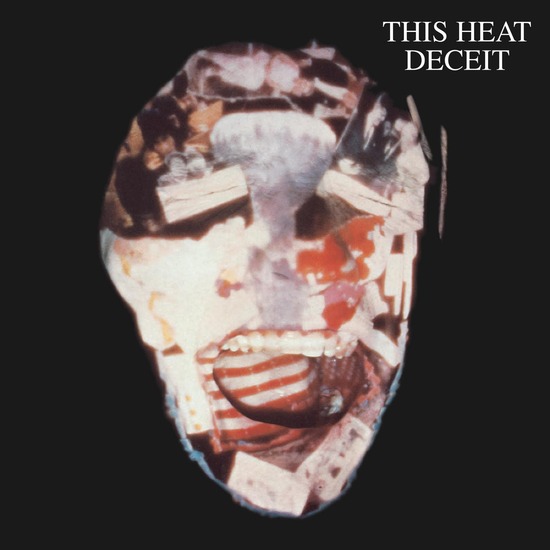
THIS HEAT - Deceit (1981)

Review by: Graham Warnken
Album assigned by: Joseph Middleton-Welling


What if “Revolution 9” were an album?

Now that I’ve grabbed your attention with that shamefully clickbaity opener—that’s not this album. “Revolution 9” was a sound collage, not a piece of music, and was probably ill-advised even though I don’t mind it so much in the context of The White Album—it’s exhausting and unpleasant, sure, but those adjectives are sort of part and parcel of listening to the Great White Whale in full (I say this with the caveat that it vacillates between spots 2 and 3 on my list of Favorite Beatles Albums), and it makes “Good Night” that much more of a relief when it arrives. And here I am writing a whole paragraph that has nothing to do with the album I’ve been assigned! “Will this long-winded git ever get to the music I actually told him to listen to?” Joseph must be thinking.

Anyway, to get back to where that diversion was supposed to be going, “Revolution 9” is not music. Deceit is, to varying degrees, although like “Revolution 9” it is by turns exhausting and unpleasant. There’s a whole lot of white noise going on, to be sure, but floating through its currents are melodies and structures and all that good stuff.

The thing is, I’m not sure that makes it better. In fact, it might have the opposite effect. The melodies, when they rear their heads, whet the listener’s appetite, but they all too soon vanish into the foam again, leaving the listener frustrated and waiting for the next palatable bit to appear rather than focusing on the ambience of the sound collage. Not to say it’s impossible to fuse melody with ambient hellscapes (witness The Downward Spiral), but I think that the former has to be more present in order to balance the equation out; as is, the record is probably 70% noise and 30% melodic, and that’s an uneasy listening experience.

It’s probably my damnable Romanticism coming out, but I don’t necessarily think the political points This Heat are trying to score are best made by an album of abrasiveness. The Wall, for example, remains for me the most successful picture of hell ever put to vinyl primarily because it’s a dance of mingled beauty and destruction, the melodies and quiet moments becoming horrifying in context and making the terror of the more abrasive bits stand out. When the terror becomes one long drone it’s really hard to sustain interest. Not to say that the kind of music Deceit consists of is worthless, or that all music must be melodic, just that in this particular instance some moments of levity might have mattered more than sheer grinding agony for forty minutes.

The production is incredible, all that said. It must have taken a lot of effort to craft this album’s sound, and I would never take that away from the band. And I’m sure that in the context of post-punk, which I know nearly nothing about and to which I gather this album was rather important, its merits become a lot more clear. This one just wasn’t for me. (Even The Wall isn’t, really. I can only bring myself to listen to it maybe once every six months due to its complete horror. When it comes to music I’m less ready to abandon pleasure than I am for films or books.)

*retreats to Anthology 3 to recover with Paul McCartney’s dulcet tones and soothing acoustic guitar*

OPETH - Pale Communion (2014)

Review by: Nina A.
Album assigned by: Graham Warnken


The appeal of metal music to the wide audience (all of its many subgenres seem to have a sizable enough fanbase) I have always found has to do a lot more with the psychology of the fans than the merits of the actual music. Not that I mean to say all metal music is bad because it is metal music. Nope, I actually mean to say that all metal music is not that special... because it is metal music. See, for some unspoken reason, metal music has to abide by the various metal music clichés and tropes, and that I find, is the thing that severely limits it and also cripples it somewhat. I was going to go on with more thoughts on the metal-loving community and their chosen genre of adoration but I feel that you folks will stop taking me seriously if I say “metal” one more time. So the reason I am bringing this up is because Pale Communion here (really, could you have picked a cheesier title) is a textbook example of my main problem with the genre: it's just trying too hard. To be badass and important, I imagine. 

Any review of this album will probably go on about propulsive drumming, anthemic electric guitars, dynamic textural passages or I don't know about its prog goodness or Middle Eastern whatever melodies but the truth is that none of this matters because ultimately the whole exercise is kinda soulless. They probably talk about friendship, betrayal, doom, hell, treason, hate, wisdom and other stuff from the high fantasy handbook of epic but it all just comes across as items off a checklist. A checklist I feel I've seen so many times already even if I've listened to like 20 metal albums in my life. Even worse, the sound of it all, for all its intellectual approach and expertise and delving into different genres and influences also ends up being this processed generic slick metal sound. And this is even more so what makes it mind numbingly boring. What’s up, metalheads of the world? Will you be considered less metal if you stopped sounding like pseudo-angsty metronomes?

Now don't get me wrong, Pale Communion (oh, how about Brooding Aubergine or something) makes for some excellent background music, especially the more fusionish track “Goblin”, and I dig how they channeled Purple on the opener “Eternal Rains Will Come”. “River”, which I suppose is meant to be the more intimate offering in this album, also flows pretty nicely and showcases some amazing taste in arrangements and the skill of the bandmates. Truthfully, I'd probably find enough nice things to say about each of the tracks here, and I suppose it is for this reason that people feel good about praising such records very highly. Fair enough. Just don't pretend this stuff is supposed to resonate with you emotionally or blow your mind artistically because in the end it all boils down to the formulaic metal checklist.

PS: There is a harmonic minor tune towards the end of “Voice of Treason” that is almost verbatim out of a trashy 90s Bulgarian pop song, which is a fun coincidence.

PS2: I can't believe this came out as recently as 2014.

PS3: At least the cover art is somewhat imaginative.

Thursday, 19 May 2016

THE WAILIN' JENNYS - Bright Morning Stars (2011)

Review by: Star Trek II: The Wrath of Khan
Album assigned by: Graham Warnken


I was going to start this review by pointing out how the fact that the name of the group was a convoluted pun on Waylon Jennings was probably the most interesting thing there was to say about them! Truth is I originally found Bright Morning Stars to be massively soporific, to the extent that I had to force myself to listen to it all the way through. And it’s no understatement to say that I really struggled to summon up any kind of enthusiasm for it. But before I continue on my way to the eventual denouement of this little tale, let me give you at least a smidgen of background on the band itself. 

The Wailin’ Jennys are a female vocal harmony trio in the country-folk-roots mould. They hail from Canada -- the band was formed in Winnipeg on the Eastern edge of the wide Canadian Prairies -- and the record, Bright Morning Stars, their fourth album, was first released in 2011. My first few listens I’ll admit to having them down as the kind of placid, overly sincere music that you might associate with say a feminist knitting circle, or a tiresome but particularly self-satisfied coffee shop. It’s not that I have any kind of problem with country music or folksy americana (set aside for the moment the fact that it’s Canadians that made this) in general: no, not at all. Indeed a lot of my favourite music would easily fit that description, or at least fall within the overall sphere of influence of those genres. It’s just, well, I couldn’t escape the whiff of cliche emanating from the album, and I found it to be an awfully dreary and generic affair at first -- but let me emphasise that ‘at first’ here. 

But even more than that, I was put off by the fact that the whole album seemed stuck in a sort of low energy trap, which isn’t much help when you consider that -- and realise I am in no way proud of this -- my main mode of listening to music nowadays is over headphones at work. And, well, I have enough problems concentrating on anything for more than a few minutes during working hours anyway, so the additional torpor induced by Bright Morning Stars made it a challenge to get through, especially on balmy afternoons with the sunlight streaming in through the blinds. I was after something much more ‘stimulating’ and so felt slightly resentful that I had to listen to the record and at least try and be half-way fair to it for the review.

Like I said this was originally gonna be a dismissive review, but at certain point my subconscious intervened and took a firm stand on behalf of these three mellifluous if lethargic folk maidens. It happened one morning, round about dawn, that I was in that strange and vulnerable hypnopompic state of mind between sleep and wakefulness, when I heard, or more accurately was haunted by the sensation of, a serene chorus of female voices, siren voices, singing a song that was so comfortingly familiar it was as if I’d known it for years. Except I hadn’t known it for years, I’d known it for about a week or so; waking up with the residue of those blissful voices still ringing in my mind, it took me a minute or so before I realised where it was I’d heard that song before -- at which point I was fairly taken aback. I mean I certainly hadn’t expected to be won over so quickly, and my mind become suddenly so attuned to a record that just the day before I’d struggled to listen to all the way through. Where I had previously perceived an insubstantiality to Bright Morning Stars, an insipidity that seemed reflective of mediocrity and a lack of imagination, I now found myself listening to music that was weightless -- yes -- but that also sounded graceful and inspired: the melodies were not lukewarm and aimless, as I had first taken them to be, instead, transformed by time and the deeper workings of the brain, I appreciated and was able to applaud their delicacy and refinement. 

Folk music is at its best when it sounds timeless -- especially, that is, when the songs themselves are new; that’s the craft. Each record, each performance, is supposed to fit seamlessly into the tradition, so as to ensure that there aren’t any jolts of the sort that used to occur every so often in rock and pop. Indeed once upon a time rock music and popular music used to thrive off of breaks in continuity, these challenges to the old order, only to emerge energised and newly relevant to yet another generation of young people. And so it would seem that the strength of folk music lies in precisely the type of continuity that rock and pop music once used to spurn; it’s not that folk music doesn't progress at all, but that it's always at a far more stalely pace. Pondering over these thoughts I asked myself if that which I had initially identified as the Jennies’ genericity -- and that I took such an immediate reaction against -- might not in the end actually be a point of strength. What matters in the end, at least as far as the genre is concerned, is the deeper resonance of the music, and on that score the Jennies are startlingly successful; they’re a revelation. The tl:dr, then, is that the Wailin’ Jennies are responsible for some very fine music here (in all senses of the word fine): music that manages to seep down into your subconscious and make itself absolutely at home there, without your really realising it and, maybe without you really wanting it -- after all what if you don’t like knitting circles and self satisfied autumnal coffee shops -- and isn’t there something a bit sinister and even a bit frightening about that? (8/10)

Tuesday, 17 May 2016

ULVER - ATGCLVLSSCAP (2016)

Review by: Graham Warnken
Album assigned by: Christian Sußner


Well, shit.

In the previous two rounds of the Only Solitaire Review Game, my luck wasn’t that great. I was assigned Preservation: Act 1 by The Kinks, which I found mediocre, and Scenes from a Memory by Dream Theater, which was pretty enjoyable if overblown. Neither one was an album that I truly loved or at the very least was intrigued enough by to want to revisit immediately.

It’s perhaps ironic that this album, which is mostly a canvas of ambience rather than a set of songs a la its predecessors, is the one that grabbed me so strongly, but there you are. Perhaps it helps that, unlike The Kinks and Dream Theater, whose reputations precede them, Ulver is a group I was utterly unfamiliar with going into the listening experience. Regardless of the answer, despite its daunting length (80+ minutes), it’s a record I want to revisit almost immediately.

I never would have known this album was mostly recorded live had I walked into it blind. True, it consists of multiple live shows overdubbed on top of one another, and additional studio trickery has been applied, but the sound is so pristine that even then it’s hard to believe any of it was recorded in front of an audience. It’s comprised of dense sonic layers, sweeping synths and chiming bells and swirling guitars and pounding drums piling on top of each other in a sound that’s misty and enticing rather than an overblown Phil Spector mood. Apart from two penultimate tracks, there are no vocal melodies, merely vague chanting and vocalizing that serve to supplement rather than dominate the music.

Without driving melodies or intricate structures, it would be easy for the songs to turn into so much ethereal self-indulgence, noodling their way into a directionless new-age haze, but this thankfully doesn’t happen. Lack of melody doesn’t mean lack of direction or power, and the record has those to spare. It’s not very helpful to say that it sounds like many great SF/F stories read, but that was the thought that kept recurring to me as I listened; there’s an otherworldly, beautiful aether that runs throughout the music. The only place this falls apart comes with the aforementioned duo of penultimate songs, “Nowhere (Sweet Sixteen)” and “Ecclesiastes (A Vernal Catnap)”. It’s here that vocal melodies become prominent, grounding the music in a way that doesn’t really suit it and injecting a force of individual personality where it isn’t wanted. This is especially damaging on the latter track, whose lyrics consist mostly of a recitation of a passage from the titular book of the Bible. Beautiful poetry, obviously, but it can’t help but feel canned when it’s sung over music; it smacks of empty pretension, as if the artist felt he had something important to communicate but fell back on a Biblical text because he couldn’t be bothered to say it in a new, interesting way. Yuck.

This misstep aside, however, this is an engrossing and frequently gorgeous piece of work. It’s already a part of my iTunes library, and I hope upon further listens to uncover a myriad of new things to appreciate.

Friday, 22 April 2016

DREAM THEATER - Metropolis Pt. 2: Scenes from a Memory (1999)

Review by: Graham Warnken
Album assigned by: Victor Guimarães


I never really feel qualified to analyze prog music, because I’m not really knowledgeable in musical theory. As a pianist of some eight or nine years this really shouldn’t be the case, but time signatures and key changes and whatnot aren’t something I’ve ever really been able to internalize. All this basically to say that I can’t really speak to the technical intricacy of anything on this album.

That said, what I go to prog albums for is an atmospheric listening experience. I listen to The Dark Side of the Moon or Pale Communion or In the Court of the Crimson King when I want to get into a certain mood, when I want to passively let sound wash over me rather than actively engage with the music. And in this respect, I quite enjoyed Scenes from a Memory.

It was always gonna be love at first sight, because the cover art is done by Dave McKean, the man who created the covers for every issue of Neil Gaiman’s Sandman comics. The Sandman connection is indicative of the thematic material that is to follow: dreams, altered consciousness, the thin line between reality and illusion, etc. etc. Of course, as with pretty much every rock opera, the story is melodramatic and preposterous when examined under scrutiny, but as that’s a given it’s easy to move past. The lyrics are also nothing particularly special, but again, that’s not why I’m here by and large.

The music, then: I listened to the album as one long suite on YouTube with no divisions between songs, so I can’t really isolate moments on a name-by-name basis. The whole, however, was remarkably pleasing. The adjective “dreamlike” is too abstract to use, and bears connotations of hazy, misty ambience that isn’t really appropriate, but the music definitely does communicate the multi-layered perceptual maze that the album is all about. Twisting, intertwining instrumentals, reminiscent of Opeth’s more recent stuff but not as heavy, feel like water trickling through one’s ears or a helix spiraling upward in the brain. It’s an album to get lost in, to be experienced in total rather than in drips and drabs.

I thoroughly enjoyed this listening experience, and look forward to returning to Scenes from a Memory and Dream Theater’s other offerings. Here’s to a proficient, enveloping musical experience—even if the story is still kinda silly.

Wednesday, 20 April 2016

TEAGUE CHRYSTIE - Adventures in Faking This (2014)

Review by: Nina A.
Album assigned by: Graham Warnken


The Internet doesn’t seem to know a whole lot about Teague Chrystie, apart from the fact that he is a visual effects artist and that he has at some point written a musical of the name “Sad Max” with another guy, named Jim Frommeyer. But this scant information does indeed put the 5-track record “Adventures in Faking This” into perspective. It suddenly does make sense that the guy who’s written it has had experience with musicals because all these songs are textbook-crafted. They showcase expert knowledge of how to do your song in this or that style, to suggest this or that. (And probably not a ton of originality, if I have to be honest).

The opening track, with the visually concrete title of “Limp-Dick Christmas Lights”, already suggests that if we’re not dealing with full on comedy here, it is at least spoofing or self-aware irony. The singing on it I’ll assign to the self-aware irony column, aping very successfully the Elvis Costello school of setting your lyrics to the music, but the musical backdrop is probably more suited to the spoofing column: there are even the obligatory announcing-a-Christmas-number jingly bells in the intro. The bombastic horns and the boogie-woogie rhythm associated dashing sleighs (or zombified shopgoers) really drive the point home here. Unfortunately, while I thought this track is super fresh and funny on first listen, by the fourth I kinda hated it the way I hate every Christmas boogie-woogie, jingle bell rock or bluesy number ever.

Next up is a delicate waltz time ballad of the name “Blank Walls and Crowded Shelves”. Now the waltz signature is used widely for such purposes as depicting nostalgia or comfort or feelings you’ve sort of made peace with or... yeah... a vignette of ordinary people's life drama, which is the use it is put to here. The string accents emphasise the whole affair in just the right way and the corny lyrics are something I find no pleasure in listening to. But hey, I know for a fact that some people can have a cathartic experience on something like this.

I feel that “I Feel More Like a Leonard”, the third track here, is supposed to be this cultural reference or a sublime in-joke but I don’t know what it is about really. Again, the energy, passion and measured shredding are just as prescribed (textbook derivatives, remember) and the 6/8 meter is a nice touch that enables this song with a driving rhythm.

The penultimate “Writing a Letter” is a gentle piano ballad, equipped with a heartfelt vocal delivery and lyrical details such as “perfectly mature adult” and “can’t stand myself”. This sort of thing would work great in a musical actually — where you have to shed light on the internal character drama and his motivations. Outside this context though, again, it is something I have absolutely no interest in learning about.

The raunchiest track on here serves as a closer to this 5-part magnum opus and this time Mr. Chrystie puts on his best Gogol Bordello impression. “The Insidious Communist Propaganda of Steve” opens on a rhythm as heavy as a drunk dancing bear from Belarus and sports the correct amount of chaotic enthusiasm to make it work, although the chorus-like “la-da-da-da”s are not nearly as drunken and tobacco-hampered as those that can be found on a Gogol Bordello record. The lyrics are probably funny too, if you can take communism puns and jokes by people who have a super vague idea of communism, which I usually cannot. In fact, why don’t we ban the word “propaganda” altogether — it certainly would make most high-school assignments more pleasant to read, as students would no longer feel the urge to use it left and right to prove they have understood the topic. It would also be relieved of its duty of a go-to word for people who cannot be bothered to do their own thinking. Anyway, the song features the obligatory spoken (or rather boisterously shouted) word coda and even gains steam to finish on a beat worthy of a balkan brass band. It does not hold as long as a balkan band would have it hold though (’cause that’s when the most frantic dancing happens), as it derails into its quirky component sounds pretty quickly. Oh and there is a scream.

So in conclusion, I’d say that Adventures in Faking This can be a fun record for a couple of listens, but I wouldn’t exactly cry if I never heard from it again. Congrats to Mr. Teague Chrystie on being so impressively good at faking this, though. The professionalism shines on all of the tracks.

Monday, 4 April 2016

ANAÏS MITCHELL - Young Man in America (2012)

Review by: Jonathan Birch
Album assigned by: Graham Warnken


Anais Mitchell is a modern folkie, in the same ilk as Bon Iver, and from the cover it’s clear what you’re getting into: the travels and travails of the Americana experience. The opening song sets the mood, with a lot of sparse guitar chords, screeching vioin, and oohs and aahs. Dorothy, we have found ourselves back in Kansas.

The second title track highlights the grievances I have with this record.  The instrumentation is professional, the production clear and pristine, the backing vocals soulful and atmospheric. But Miss Mitchell’s voice could not be more twee and precious, as though she is purposefully emulating the intonations of a twelve year old valley girl from southern California. It was one of those things I could just not move past, save for when she briefly stopped singing, and it hampered my enjoyment of the rest of the record. Something about the overly earnest and cherry sweet delivery made me wince whenever her voice squeaked into my ear canal. Which is a damn shame, because everything about it is easy to like. The second track begins as a simple folk ballad, before morphing into this New Orleans jazz-style tale of a young girl’s journey to adolescence. It’s both simultaneously moving and annoying to listen to. It does finish with a little bit of flourishing flute work, so that creates a nice high note at the end.

Third song, “Coming Down,” has a lot of teary eyed emotion to it, with Mitchell singing about the time she got very high and laughed so loud. I’m not sure what the message behind the song is, but it’s very pleasant with the breezy backing harmonies and crisp playing. It gets better on “Dyin Day,” a country/bluegrass piece with a slightly more energetic feel. I’m no longer dozing off but tapping my feet to the steady beat and groovy mandolin solo. Miss Mitchell seems to know the way to my roots rock heart. “Venus” is a pleasant little number about the singer discovering her womanhood and meeting the Roman goddess Venus. A nice electric guitar shuffle melds with jovial accordion solo, which really tickles my earbuds. How can one not feel happy when listening to such optimism?

The rest of the songs do sort of blend together after a while in this pudding of syrupy folksiness. The lyrics do begin to travel bit heavily into biblical, country-bumpkin, John Steinbeck-ish territory, as Mitchell wails about how her daddy “was a builder who swung his hammer brown and silver” or “how she sowed a party dress with a needle and thread.” It’s almost like she’s trying her darnest to convince me how pragmatic and salt of the earth she is. Because she’s from rural Vermont you see.

The track “Tailor” has a fair bit of annoying, and dare I say ostentatious lyrical utterings, where she repeats some seemingly innocuous phrases over and over, such as “In and out, In and out, In and out,” or “Who am I? Who am I? Who am I?” I don’t know Anais, I wish you’d get to the point and tell me though.  Apparently the album was designed to tell a story that relates to the recession of ’08, and Miss Mitchell seems to anoint herself as the voice for the zeitgeist of modern America’s alienated youth. But her themes never seem to expand beyond the superficial side of longing for love and motherhood, and her overall style is slightly too drippy to carry any weight; the track “Shepherd” sounds like something I’d hear on a commercial for Johnson’s baby powder. Supposedly it’s based on a short story her father, a college  professor and former novelist, wrote, which I appreciate for its honesty, but the self-indulgent audacity of it is rather cringe worthy too. Miss Mitchell, I understand you come from a long line of distinguished bards, but your poetry need some more bite for it to catch my interest.

“You Are Forgiven,” the second to last track, is slightly more rocking. Which means that the acoustic guitar is strummed a bit faster and we finally have some drums. There’s even a nice trumpet solo that adds some spice, but by now it’s too late to enlarge the horizons of this record beyond the obvious. It’s clear this was designed as one of those albums you listen to intently on a sultry evening, but there are billions of these homely folk albums that I would be willing to recommend in its place. It’s slightly less labored than your average Red House Painter’s record, but not as atmospheric as The Cowboy Junkies. It’s somewhere on the scale between enjoyable and pleasantly mediocre. 

Wednesday, 16 March 2016

THE KINKS - Preservation: Act 1 (1973)

Review by: Graham Warnken
Album assigned by: Alejandro Muñoz G


I had never actually listened to The Kinks before outside of a few isolated songs, so I was excited to do my first full album by them. Unfortunately, I think I’m forced to agree with the mostly negative reception it’s gotten.

The production is uniformly wonderful, which is a big plus, and musically a lot of the songs are pleasing enough. If there’s a plot to this rock opera, however, I can’t see one. Worse yet, the lyrics are utterly grating. Davies wants to be a cutting satirist but he paints with far too broad a brush and far too simple a sentiment to come off as anything other than smarmy a lot of the time. Where Randy Newman’s satire is horrifyingly cruel because it’s laced with empathy and pity, Davies clearly considers himself above most of the people he’s describing and treats them as such. It’s not amusing, it’s obnoxious.

As said above, I mildly enjoyed a good deal of the album’s melodies, but they can’t rescue it from the lyrics for me. Having seen that this is generally considered the beginning of the end for the band, though, it won’t deter me from eventually seeking out their earlier work.