WELCOME TO OUR NEW SITE: tomymostalas.wordpress.com

You'll be automatically taken there in a second.. Change your bookmarks, thanks!

Showing posts with label Mark Maria Ahsmann. Show all posts

Thursday, 13 October 2016

STEFAN VALDOBREV (СТЕФАН ВЪЛДОБРЕВ) - ...to (...към) (1998)

Review by: Mark Maria Ahsmann
Album assigned by: Nina A.


…към features fairly decent but not outstanding and somewhat generic 90's pop rock. The songs are all well arranged – in particular I like the sound of the lead guitar which seems influenced by Reeves Gabrels' work with Bowie on Hours. And the singing is competent. The overall sound is upbeat, accessible, melodic, mostly based on drums, bass, (alternating acoustic and electric) rhythm guitar and lead guitar. On some places horns and female vocals are added. There are a few excursions to other genres, like light hiphop on “Da”. It all sounds a little derivative though I can't really pinpoint it to any artist that would be an obvious example. Though sometimes U2 comes to mind – I don't mean that in a bad way.

Apart from the language in which it is sung and some minor details in the arrangements (like the start of the first song “Nov”) the sound is very Western – you wouldn't know it was a Bulgarian album apart from that.

All in all it was a mildly pleasant listening experiment though I found the refrains of some songs quite cheesy. Especially on the first song, I found that really so off putting that at first it coloured my view of the whole album.

Sunday, 25 September 2016

DE KIFT - Vlaskoorts (1999)

Review by: Syd Spence
Album assigned by: Mark Maria Ahsmann


De Kift is a band that plays a modern reconstruction of early 19th century cabaret music. All of these tunes seemed born from working class music halls during the turn of the 20th century, and then given a slight discordant modern touch with the odd arrangement or spoken word bit. It’s not too discordant to off shoot the old fashioned songs, but it’s enough to know that the musicians probably own a few Einsturzende Neubauten records. The question though is it any good? And that’s where we have a problem. 

I came to this record with multiple prejudices and inadequacies that hinder my enjoyment. One, It has taken me lots of repeated listenings to jazz, soul, and reggae records to not hate brass instruments. I come from America and the tradition of big brass bands playing in our sports is an endemic anachronism, and I find those old war marches a combination of quaint and shrill. Cabaret brass comes from a similar heritage and despite a bit of a jazz influence on this record, it still has that frumpy uptight feel. 

Two, I really hate accordions. I don’t know why exactly i’m turned off by them. Where i’m from, the accordion is super popular with Mexican Americans and Mexican immigrants, and perhaps some hidden racism or classism is afoot. It’s the main instrument in tejano music which is a combination of Mexican folk and German polka music. I’ve always loathed it, as well as polka music. Something about the rhythms just seem so sexless, and uptight. And polka is a hop skip and a jump from cabaret, or is literally a subgenre of it. I really don’t know much about European folk brass dance music. In my mind, Europe’s best musical invention was combining synthesizers and disco rhythms, and well, this is a long way from Giorgio Moroder. 

And last, I’m American. I speak one language. It’s ridiculous and limiting, I know, so the parts where spoken word poetry is happening, I tune out. It’s not melodic and I don’t understand what’s being spoken. I have hunch it’s political in some regard but i don’t know. The cleverness or beauty of the poetry is completely absent in my loathsome ignorance.

So I did not like this album, but I feel i have no real way to adequately critique it due to my prejudices. I will say that they didn’t go far enough beyond cabaret cliches to make me question my prejudices. I have heard some gypsy punk and dark cabaret groups that make me second guess my hatred of old European dance music. This just made me want to delete it from hard drive as soon as possible.

Thursday, 22 September 2016

IVY GREEN - Ivy Green (1990)

Review by: B.B. Fultz
Album assigned by: Mark Maria Ahsmann


Note : I was one of the two or three people that asked for a good album to review, rather than a deliberately bad album, so this review will not be a “panning” per se. I thought maybe this was important to mention because nearly all of the other albums in this round were bad (at least in the opinion of the people who assigned them).

Ivy Green is a late 70s punk album by the band Ivy Green. It has most of the earmarks of early punk -- short song lengths, simple chord structures played at a fast tempo, and clipped, snotty-sounding vocals where you can't always make out the words but you know it's something being repeated over and over. It's very much a straightforward punk album from the days when punk was still new and exciting. The band does a competent job with it, as long as you don't mind them borrowing from other bands left and right. You've heard all these songs before, even if they were different songs by different bands when you heard them. 

The Ramones influence is obvious from the very first song. As soon as you hear the chainsaw buzz of "I'm Sure We're Gonna Make It" you know where these guys are coming from, and have a good idea where they're going. The more you listen, the more shades of 1978 you'll find. "Another Sub-Culture Going Bad" has the barked vocal style of Johnny Rotten over a simple guitar phrase that would be right at home on Bollocks, and "Sue" sounds like some obscure 60s surf rocker that would have been covered on the Great Rock & Roll Swindle. "Why Not Tonight" also sounds like a song from the early 60s updated for the punk age -- the rockabilly drive on that one reminds me of Johnny Cochran. I can't tell if Ivy Green listened to a lot of 60s music themselves, or if they subconsciously picked up that sound by imitating other punk bands who listened to a lot of 60s music. 

They settle into this basic punk/proto-punk groove and stick with it for 36 minutes. Once in awhile they deviate from the pattern (a little) -- "Every Day The Same" has some breaks in the monotonous guitar-buzz where they try for something a little different -- but for the most part the songs all sound similar, and rarely stray beyond the stereotypical punk sound of 1978. 

The album is very much a product of its time, with all the good qualities (drive, youthful aggression, cool guitar tones) and bad qualities (stripped down structures, monotonous sound) that go with it. If you like punk, you'll probably like this album. If you dislike punk, you'll probably hate it. Ivy Green doesn't try to be much more than just another punk band, but what they try they succeed at. Which is more than you can say for many other bands who tried for bigger things and failed. And even if Ivy Green’s debut was not exactly a milestone in the history of music, it's a pretty cool album all the same.

Monday, 15 August 2016

ZEZÉ DI CAMARGO & LUCIANO - Zezé Di Camargo & Luciano (1991)

Review by: Mark Maria Ahsmann
Album assigned by: Francelino Prazeres de Azevedo Filho


Oh, I’ve heard beautiful things: the first four notes of Zezé & co’s version of “And I Love Her”, “Eu te amo” performed by deep and low strings bring the hidden melancholia of this song to the surface so that instead of a contemplative and happy love song it turns into a contemplative wistful and sad love song. I could easily imagine a band like the Tindersticks using that as a template for an autumnal version.

These four notes are the only things that are truly outstanding on this album. The rest of it is a dime a dozen sun, sea and beach & bikinis pop music.

This kind of music is sort of timeless and sort of locationless. They’ve been producing it all over the world since at least the late 1960’s.

I find it not too repulsive though obviously it is not “good”. It is not meant to be.

In my country there’s a TV program called Music Party On The Square. Dutch versions of Zezé & Luciano lip sync their latest hits before a mildly enthusiastic crowd. Spectators always start to dance spontaneously when they notice that one of the TV camera’s picks them up. I’ve always wondered what it would be like at such a party.

This album is very suitable for cafeteria’s and half price pizzeria’s.

My colleague says Zezé and Luciano are actually Ron and Russell Mael in disguise. And she would like to add that Russell’s mullet was fabulous in 1991.

Friday, 6 May 2016

SUFJAN STEVENS - The Age of Adz (2010)

Review by: Mark Maria Ahsmann
Album assigned by: Francelino Prazeres de Azevedo Filho


Sufjan Stevens gives you constipation of the wrong kind. The right kind is constipation caused by for instance Phil Collins; when you hear the music and you instantly know it’s bad shit. Your body cramps up and it takes you a few days to get it out of your system if you just set your mind to it.

The Sufjan Stevens constipation is different. It consists of a lengthy inability to figure out if you like his music or not and if is his music is good or not. It might be best to avoid this kind of constipation altogether but you agreed to write a review of “The Age of Adz” so you had to deal with it.

So you listened to the album. You heard an album by an acclaimed multi-instrumentalist singer-songwriter who for a change used mainly electronic instrumentation to accompany vaguely confessional reflections on love, sex, life and death. You heard some things you liked, more things you disliked and many things that made no sense to you

You listened not once or twice but fifteen to maybe twenty times over a couple of weeks. And it was a strange experience because the album appeared to have the properties of some old fashioned psychology test, like a Rorschach test but not quite similar; the album seemed to reflect your mood in such a manner that on alternate listens you would either like it or severely hate it. You did not hear anything new or different in it and you could definitely pinpoint some things you loved or hated in it but you could never predict what your emotional response to it would be. Let alone analyze it or summarize in one sentence what informed your judgment. Add to that the fact that even after several hearings you could not reproduce a single detail of the album in your head; even “The Division Bell” performed better on that score.

You developed a mild obsession with “The Age of Adz”. You thought about it and the review you had to write all the time and in your mind you had already written a dozen different versions of the definitive review you are about to write. You knew what you liked about it but you were anxious that you would never figure out what you disliked about it so vehemently. 

Nor could you really decide if this would be a “Recommended-Album-Despite-All-It’s-Obvious-Flaws” or “Seriously-Flawed-Album-With-Touches-Of-Brilliance” type of review.

And you put off writing until the very last moment. And you fear that your Sufjan Stevens obsession will become a lifetime occupation.

Awful constipation.

Then finally you set out to write the review. You start off by mentioning the things you like about it and the thing you like the most about it is the beauty that can be found in the details of the arrangements. As one would expect of Sufjan Stevens the album is meticulously crafted and multi-layered and he uses a many sometimes unusual but often pleasant instruments to adorn his pieces. And when that approach works it is really quite good. Instances of this are strewn across the album; for example the horn coda on “Get Real Get Right” is really beautiful. Also the big-fartin’ electronic drum and bass foundation and the glitchy, slippery synthesizer sounds are at the very least fun. And you should mention the celestial female backing singers on many of the tracks but especially on “I Walked”; they are really delicious. As the sum of all it’s different parts “The Age Of Adz” is really a unique album. But that doesn’t necessarily make it a good album. In fact you have a number of problems with it that one by one wouldn’t be so disastrous but when you add them all up you are stuck with an album that is only partially palatable, in small portions.

The biggest problem is that even for a Sufjan Stevens album there’s a lot of Sufjan Stevens on it. Too much, in fact. One has to, for example, like Sufjan Stevens’ voice to fully appreciate this album because on this album at least there's no escaping it.

You dislike his voice. He sounds so sincere and introspective that after listening to it for a while you think Lemmy and Antony are the same person. It's so intrusive and all over the place that it reminds you of Freddie Mercury. And you don't like Freddie Mercury, to put it mildly. Furthermore, Stevens sounds so sterile, sexless and dorky that it's like he lived in Mike Love's throat for a long while. And he has a tendency to crack into falsetto all the time.

You dislike the density of the sound. It's so stuffed to the brim with little cosy, well crafted, pretty ornaments on top of ornaments on top of bombastic or------------------------------------------------------------------------------------------------------------------------------------------------------------------------------------------------------------------------------------------------------------------------------------------

THE MOTHERFUCKER'S ELUDING ME

Look, it took me too long to write this review and that's because so far I don't understand what I like about it. It's quite obvious what I don't like about it. The voice annoys me. The album is overcooked like somebody produced a cherry pie with not just cherries but also apples, kiwi's, strawberries, pineapples, pears, peaches and etcetera and what have you.

I think “Less Is More” is a valid principle but I can appreciate a certain lushness, for instance on Pet Sounds, if the embellishments at least serve decent songs. This album, however, lacks memorable hooks and the one song that sticks in my memory “I Walked” is uncomfortably similar to Dido's “Thank You”, of all things. Many pieces consist of repetitive chord sequences with varying instrumentation, chanted phrases and with Stevens' voice to the fore that can be very off putting. Take for instance the title track; it is just awful.

Stevens’ lyrics do nothing for me and I am non-plussed by the combination of supposedly intimate lyrics and very bombastic arrangements. On “The Age of Adz” Sufjan Stevens comes across as too eager to please and impress. He reminds me of a guy I once worked with who would, at the mere mention of the word coffee, jump up and get you a cup. Awful, servile creep. Seems like Stevens strives for beauty but never achieves more than prettiness. And thereby he leaves nothing to the imagination of the listener.

And what’s sorely missing is anything that really kicks ass or lays down a groove. Yes he applies a disco rhythm in a section the overlong (25 minutes), seemingly pointless and tedious album closing suite “Impossible Soul” but it does not take me to Funky Town.

So all in all there are so many things to dislike about this album for me that I would obviously dismiss it completely and put it in the trash bin of my mind. If it weren’t for I don’t know what.

And for me that’s the most intriguing thing about “The Age of Adz”; that in a certain light and at certain times I quite like it. Like a guilty pleasure, maybe. A very annoying guilty pleasure though. It is something about the atmosphere, and yes , of course some bits and pieces are quite beautiful. But in the end I just can’t figure out what’s the up side to “The Age of Adz”.

And frankly, at the moment I just don’t feel like delving any further into it. I’m tired (of it).

So, there it is: a failed review attempt.

When I was a kid my family used to own a jigsaw puzzle which was insolvable. The last piece would never fit. My mother promised five guilders to the kid that could finish it. Of course no one ever earned that money. Until I took a hammer and forced the piece into the puzzle and my mother, exasperated and because I was the youngest of the eight, paid the sum.

If I were to think any more of Sufjan Stevens I would like some money first.

Wednesday, 20 April 2016

THE SAINTS - Eternally Yours (1978)

Review by: Michael Strait
Album assigned by: Mark Maria Ahsmann


Okay, so, on the three major components to this album:

  • The guy’s VOICE. He’s probably the most Australian vocalist I’ve ever heard in my life, and he’s such a quintessential rock singer too. Utterly snotty, disaffected, rough and raw, contemptuous – and yet also capable of projecting surprising amounts of personal emotion when necessary, not to mention carrying a tune if he really exerts himself. He’s a sarcastic rock n roll demon with some personal demons of his own; in other words, he’s like Mick Jagger if Mick Jagger was genuine. He’s my favourite thing about this album, and the chief reason I’m planning on seeking out some more Saints in future.
  • The guitars. They’re what you might expect from a punk rock album recorded in 1978 – scuzzy buzzsaws aggressively sizzling about at high speeds, playing mostly chords and riffs. There’s a few cleanly-picked segments (well, clean here being contextual; they still sound like they’re struggling to swim their way out of a cloud of fuzz). The riffs, thankfully, are great, inventive and catchy stuff, and the few solos (still more than the average punk rock album of the time, mind) are a little amateurish but usually quite blistering and cool.
  • The rhythm section. The drummer’s pretty good, all told, but unspectacular – he rarely draws attention to himself and instead just focuses on keeping time in a way that is just primal enough to not be boring and just professional enough to not sound lazy. The bassist is the real talent here, I think – his basslines are all super cool, noticeable, swaggericious and precise, and his tone ain’t bad at all.

Now, as for individual highlights: The first track, “Know Your Product”, is one of two tracks to contain noticeable horn arrangements. They’re used awesomely, and create probably the most memorable riff on the album. It’s fascinating just how well these pristine, majestic instruments blend with the mudslinging guitar and acidic vocals, but they really do fit perfectly and it makes me wonder why more punk rock bands didn’t think to do something like this.

There’s also three acoustic tracks on the album. I wouldn’t call any of them ballads, and in fact only the middle one – “A Minor Aversion” – is really noticeably slower than its surrounding electric rockers. All of them are awesomely evocative, anyway. They sound a bit too irreverent, irreligious and acerbic to be redolent of the American west, but they certainly sound like an old wooden dive bar in a desert somewhere, which I guess is fitting considering that Australia’s probably the only other place in the Anglophone world you can really find those sortsa joints. The vocalist in these songs really fits in perfectly – I can’t picture him as anything but a leather-covered, gun-toting motorcyclist fleeing some distant personal failing, kinda like Mad Max without the civilisational collapse. The harmonica used on one of the electric rockers – “Run Down” – adds pleasingly to this impression.

The track “This Perfect Day” is two and a half minutes of fuckin’ punk perfection, and I love it. Aside from this wonderfully, effortlessly cool clean guitar bridge which – again – sounds like the soundtrack to a cowboy walking through a tiny Australian outback town, the chorus sounds like it’s constantly falling over itself again and again in preoccupation with the vocalist’s self-loathing. This is how self-loathing in rock music really SHOULD sound, by the way – disguised, presented as a careless spit in the face of the world that he’s trying to hate in order to distract himself from himself. This song is part of a string of tracks, starting at track 7 and lasting the rest of the album, that doesn’t breach 3 minutes long, and that’s just what I need from my scuzz-rock. Lawd knows this kind of music can get tiresome if it sticks about for too long – I mean, a leathered-up biker cowboy might be fascinating to have in your town for a bit, but do ya really want him greasing up your spare bed for a week?

Some other things of note include: the riff on the final song, “International Robots”, which is such an exact and precise rhythmic match for the riff on Green Day’s “American Idiot” that it makes me suspicious of the latter group; the guitarwork in the chorus of “No, Your Product”, which sounds like it’s trying to reach the sky before flaming out and falling down into the sea like an early SpaceX rocket; the chorus on “Private Affair”, which is just gloriously catchy; and, finally, just the general joyousness I feel from this record. That might seem contradictory, considering how much I’ve just been talking about the guy’s self-loathing, but this music really does sound as if it is enjoying its rebellion against the world on at least a primal level. After all, even if you’re running from winged demons on a motorcycle, there’s gotta be some pleasure in the visceral thrill of going so fast, and that’s what I get out of this album. It’s characterful, soulful, genuine, evocative, powerful, loud and, best of all, damn good fun – listen to it at once.

Friday, 25 March 2016

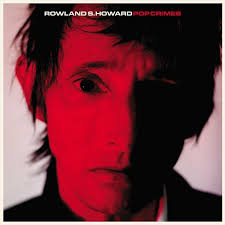
ROWLAND S. HOWARD - Pop Crimes (2009)

Review by: Mark Maria Ahsmann
Album assigned by: Andreas Georgi


After all these years it's nice to hear from Rowland S. Howard again – no surprise though.

By the time the Birthday Party ended in 1983, Nick Cave was sick of Rowland S. Howard and his omnipresent guitar and decided not to take him along into the Bad Seeds but trade him in for Blixa Bargeld and his much more sparse guitar. As both gentlemen weighed almost nothing at the time the trade in can't have been too hard on Cave's back.

My budget was also quite sparse in these days and, as a lover of the Birthday Party, I did buy Nick Cave and the Bad Seeds albums at the record store in my hometown but I couldn't afford to travel to Amsterdam, Brussels or London to purchase the various releases by Howard, be it solo or in various bands. So I lost track of him, apart from occasionally hearing the stuff he did with Lydia Lunch at that time.

Obviously I was curious to know what became of his music when I was asked to review his 2009 release “Pop Crimes”. I found that his sound is basically unchanged. “Pop Crimes” could have been released in 1985 as well.

I was a bit disappointed at first until after a couple of listens I realised that it is a very pleasant and well made album nonetheless. And of course to me it feels like home.

So: “Pop Crimes” is a short (38 minutes), well arranged and accessible album by the former lead guitarist of the Birthday Party, released in 2009; the year of his death. It contains eight songs of which six are originals and two are covers (“Life's What You Make It” by Talk Talk and “Nothin'” by Townes van Zandt). The style of these eight songs varies from defiant, dirgelike and bluesy goth rock to mournful dream pop. The lyrics are ruminations of a bad boy in a worse world. One of the chief attractions is Howard's guitar playing; sharp as surgical scissors yet soothing as the nurse who handles them.

Howard also sings and for 38 minutes that's alright with me – the guy is not a singer by birth. He sounds like a cross between latter day Joey Ramone and Leonard Cohen when he was losing his voice on “Death Of A Ladies Man”. Which wouldn't be a bad thing of course if he didn't also sound like he was trying to gulp down a pint of peanut butter at the same time.

The songs are all decent though not spectacular. Highlights for me are: the darkly suggestive dream pop duet “A Girl Called Jonny” (about a girl called Jonny and she also bangs the drum – did the guy listen to the Waterboys in 2009 or what?), the from life affirming to menacing makeover of “Life's What You Make It” (with a double bass and piano line that sounds a lot like ditto in the Bad Seeds' Cabin Fever), the dirty rocking title track with a fantastic bassline and the mournful love lost song “Ave Maria”. Letdowns there are none.

“Pop Crimes” was released in the year prior to Howard's death and I wonder if that knowledge is really important for your apprehension of the record. I don't think so; the record does not really sound like a black star to me nor do the lyrics hint at Howard's End as far as I know (of course the lyrics hint at the End in general but that's par for the course with the genre).

Wednesday, 16 March 2016

TC MATIC - L’Apache (1982)

Review by: Eric Pember
Album assigned by: Mark Maria Ahsmann


I’m always down for post-punk, so this album was a good recommendation for me. I’m so married to that school of sound that I knew that I’d be keeping this album for my collection after only listening to the first three tracks.

The sound here is reminiscent of Ian Dury, in that they’re a very tight funk-influenced band backing up an eccentric-sounding vocalist. The music is less diverse and inventive than Dury’s, however. Nonetheless, their music still has a certain cleverness to it that makes it attractive to me.

The English language lyrics were unexpected, but are a pleasant surprise. Considering that and the accessible (by the standards of the time) sound, it’s a wonder that these guys didn’t make any waves anywhere outside of Belgium. I fully expect them to become more well-known on an international scale after one of the members dies, like what happened with Soda Stereo (who I still have to listen to in full sometime).

Sunday, 6 March 2016

THE YOUNG GODS - L'Eau Rouge (1989)

Review by: Mark Maria Ahsmann
Album assigned by: A. A.


The Young Gods are an industrial rock band from Switzerland that was formed in 1987. In 1989 they released “L’Eau Rouge”. Which is a delicious album. A rock album. 'Rock' as in 'Adrenaline Music for the Young, Courageous and Romantic’. And it kicks ass, as the saying goes.

Though not revolutionary in any sense it offers it’s very own and well balanced mixture of elements already known in industrial music.

The album is stitched together from samples. Sampled metal guitars (Motörhead meets Killing Joke meets Anthrax), Front 242 style pulsating beats, samples of various styles of classical music and, most uniquely, samples of fairground organs and accordeons as used in musette, middle European cabaret music and french chansons.

The album is extremely tastefully produced by fellow switzer Roli Mosimann, collaborator with Foetus in his cockrock-parody Wiseblood project and former drummer of the Swans. Both influences are quite obvious in their music. From Foetus they borrowed the samples of classical music, - in the vein of Stravinsky and Wagner & horror movie soundtracks strings. From the Swans the extremely heavy drum sound and sonic clarity. Traces of vintage NDW acts like Grauzone (also from Switzerland) and Palais Schaumburg can be heard too. And Laibach, by the way, a band that has the use of classical samples in common with Foetus. Also a band that never eschewed a martial drum beat when one was called for.

But The Young Gods didn't inherit the brutality and atonality that made the industrial predecessors mentioned at times so harsh and to some ears unlistenable. L'Eau Rouge is a very accessible album in which the various elements come together in a logical and organic manner. It is true that none of the elements mentioned are unique. The Beatles sampled fairground organs on “Being for the Benefit of Mr. Kite” and Foetus did the same on “Finely Honed Machine”. Pig also used that sound on Hildelinde. Ah, and not to mention Tom Waits. Samples from classical music and horror movie soundtracks were, by the 1980's, all over the place of course. What sets the Young Gods apart though is the effectivity with which the band uses these elements in a heavy rock context. Without sounding overwrought or willfully experimental. And pretty much sounding like a missing link between Laibach and Rammstein, come to think of it.

Without sounding morbid too. Though I can't comment on the lyrics. My french is not good enough for that. I read somewhere that the title “L'Eau Rouge” refers to menstruation and I think that the track “Charlotte” is about female masturbation. But that's as far is my interpretation of the lyrics goes. However, “L'Eau Rouge” does not sound like it was created by a bunch of sickos. It just sounds too light, too accessible for that (but not quite Right Said Fred yet).

The album is consistent all the way. But there are some favorite tracks: the first track; the title song “L'Eau Rouge” opens in waltz time signature with the fairground organs and chansonesque vocals in place. Then it gets sprinkled with drops of classical sounding strings and just when you think it'll explode in a relentless 4/4 beat something completely different happens. That's a perfect opener. The second song, “Rue des Tempêtes” is a breakneck speed metal song, the best Ministry song the Ministry never did. “Charlotte” too uses the fairground organs in 2/4 time signature and with bits of accordeon actually develops into a very pretty song. And on “Les Enfants” the band uses the classical samples in an oragstic manner and to such a great effect that it has Laibach flat on it's back.

I have one complaint. The singer, Franz Treichler, is trying very hard to bellow and growl in the customary Foetus/Michael Gira/Nick Cave-in-his-Birthday-Suit manner and his voice is just not forceful and expressive enough to pull it off. So he relies on layers of echo but still doesn't really convince me that he's not a nice college-educated boy. Roli Mosimann should have advised him to develop his own style.

But all in all it was a pleasure to meet “L'Eau Rouge”.

Sunday, 21 February 2016

MANASSAS - Manassas (1972)

Review by: Mark Maria Ahsmann
Album assigned by: Jonathan Birch


By the time he left home in 1975, when I was seven, my brother Fred must have had about fifty rock albums. There are three categories: in the first are the albums of which I remember the cover and I remember liking the music (for example Relics, After the Goldrush and Full House). In the second the albums of which I remember the cover and I remember disliking the music (for example Tommy, Fragile and Okie). In the third are those of which I only remember the cover. Stephen Stills Manassas is in the third. And it's the only one in that category, now that I think of it.

I must have been unimpressed with the music and impressed with the cover. I still think it has a very good cover. That's one of the assets of the album; if you don't like the music you can always hang it on your wall. It is that good.

Manassas is very much a product of the early seventies when rock musicians operated under the general assumption that they had created, in Woodstock and Haight-Ashbury mainly but in other places as well, a revolution of peace and love. A chain of events that became known, simplified, as the sixties, or the Sexual Revolution or the Age of Aquarius. You know, man!.. Most, if not all, of the “rock music” in the seventies was inspired by those events. The inspiration could take the form of retreat, (Dylan becoming a family man and joyfully singing about the joy of bundles of joy and spreading the joy of country music) or the inspiration could be a counter reaction (anyone from Lou Reed to Bowie to Black Sabbath embracing Satan and sarcasm). And by the time Manassas came out some of the more intelligent rock stars had second thoughts about it (like John Lennon, Neil Young and Jackson Browne). But many rock musicians weren't that perceptive and were not too modest to proclaim themselves the Gods of the new revolution and spread it's euphoria through words and music. A euphoria that now, to my ears, sounds false and stale.

Stephen Stills was one of the latter. No wonder, he was one of the chief perpetrators in Woodstock.(So was Neil Young, by the way, but he may have written the song about Stills but it really is he: The Loner.)

And so it's Post-Woodstock Euphoria that you are served on Manassas. And I do have the impression it is served at least routinely, almost against the will of the servers. Reluctantly. Because in spite of all the pomp and circumstance, all the professionalism and all the self congratulatory swagger I miss the spirit the sincerity and energy of rock and roll in most of the music on Manassas. And to be honest, I miss it in a lot of music from that era.There's been a trade in; youthful exuberance for stale, routine euphoria. And self-importance.

That you can hear on Manassas. Mainly in the rock songs. It's in the wide-eyed, over-emoting “sincere”, “soulfull” singing style of Stills. It's in the arrangements, stuffed to the brim with embellishments; leaving the songs no room to breathe. It's in the hooks of said songs; there aren't any. And it's in the pretentious but meaningless lyrics like:

“A superb point of reference detected
becomes absurd with a moment's reflection
leaves one a passage of simple thought
not sagging with excess weight of excess baggage
and we move around
We move around “

Manassas was an attempt of Stephen Stills to break away from the dependance on Crosby and Nash and finally Young. So he recruited a number of usual suspects of which Chris Hillman is the most wellknown. But it never really became a functioning unit because of various members joining all kinds of other timely outfits, not rarely with the already mentioned Young, Crosby and Nash in different constellations. It is fun reading up on the history of Manassas, I think they call it incestuous?

Actually, I have the impression that being a rock star was an ordeal for Stills et al. Much of the album sounds like hard labor and mostly so the rock songs. I feel pity for them; to be a major figurehead of such a sea of hair and remain godlike about it must be hard. (By the way; there are two songs with lyrics dedicated to the life and loves of a rock'n'roll star so Stills must have been reflecting on that subject a lot. Unfortunately the lyrics are very shallow and clichéd.)

So that's my main impression of the album; that it sounds tired and it's energy sounds second-handed and artificial. And in that it is symptomatic of a lot of classic rock. It is probably needless to say that I'm not a big fan of classic rock, so there you have it.

But Manassas does have a lot of redeeming qualities. It is a double album of which side 1 (The Raven) and side 4 (Rock & Roll is Here to Stay) consist mainly of rock songs (sometimes more bluesy and sometimes a bit funky). Side 1 is arranged like a suite,with rapid transitions from one song to another so that you don't get bored and almost fail to notice there are no actual songs. Side 4 offers no such pleasure; the songs sound obstipated and overlong. It closes with a bluesy acoustic solo song “Blues Man” on which Stills ruminates about the deaths of Al Wilson, Duane Allman and Jimi Hendrix. Unfortunately the song is unremarkable and it's lyrics so bad that it's truly an embarrassment. Both sides mentioned are at some points livened up by Latin percussion. Which is welcome.

Side 3 (“Consider”) is also quite unremarkable; it is filled with folk rock songs and none of them stand out in any way except the hippy-sentimental “Johnny's Garden”. Funny lyrics that one has, too:

“There's a place
I can get to
Where I'm safe
From the city blues
And its green
And its quiet
Only trouble was
I had to buy it
And I'll do anything
I got to do
Cut my hair and
Shine my shoes”

Now at least we know that Stills cut his own hair, quite unlike his fellow golden retriever Crosby who would rather die than do any such thing because he felt like he owed it someone, which explains why Stills looks better in photographs. And the moustache, or rather: absence thereof, of course.

Where was I? Oh yes: redeeming qualities. There are six, apart from those already mentioned. Six splendid, yes fantastic country-rock songs on the second side of the album (“The Wilderness”). Oh, maybe five and a half, because I find “Don't look at my shadow” a bit corny. But the other ones are really great, heartfelt and not mangled by rock star posturing. Of these the break-up song “So Begins the Task” is the best; easily one of the best songs I heard for months.

Conclusion: Manassas is an album that's seriously flawed by the stylistics of the era in which it was created and the position the creator had in that era. But it still has a lot going for it. And if you wish to demonstrate how country rock offered an escape from the deathtrap of rock goddism for rock stars in the early 70's Manassas is extremely useful. & do listen to the Wilderness!

Thursday, 18 February 2016

COLD SPECKS - Neuroplasticity (2014)

Review by: Lex Alfonso
Album assigned by: Mark Maria Ahsmann


Jangly guitar leads. Take a shot.
 
After over half a decade of listening to albums as intently as a guy with no life might, I’ve developed certain Pavlovian responses to things. To wit, a lot of Neuroplasticity triggered an immediate and inexplicable sense of dread and exasperation. I slumped into my seat, blew out a short puff of air and my eyes rolled right around my head as if independently. This record is so ‘2010s indie’ that it is destined to age poorly. Every aspect of it feels like it was taken from another, more successful record. Post-rock guitar leads introduce the lion’s share of the tracks here. Bright synths chug away behind the mix. Vocalist Ladan Hussein croons away, fighting against a beating war drum. By 2014 these traits have been used and re-used so often they’re starting to look like Bill Buckner in the tenth inning. However, like Bill Buckner, it could just be that they’re misunderstood.
 
The real tragedy of Cold Specks is that, for all her unoriginality and for all the routine of it it’s not a bad record. Misguided? Sure. But through its faults it’s actually incredibly difficult to dislike. Be disappointed in, perhaps, but not dislike. It’s the consistency, partially. Consistency is the one trait it chose to be contrary to its predecessors. It’s short, for a start. That’s not the snooty “self-important-critic-who-has-given-up” critique it sounds like, either. I’m not sure when the world collectively decided to shun any LP that dropped below the arbitrary length of 45 minutes, but can we get over it, already? The album is paced brilliantly, each idea and concept present just as long as it needs to before gracefully segueing into the next song.  There is an attention to detail in the way these songs fade in and out that demonstrates a commendable commitment to the LP format. Each song concludes as if momentum is taking its course. Instrument after instrument stripping itself away until the song’s core essence is all that remains, lingering long enough on the palette to make its point before coming to a complete stop. The next track will, invariably, begin in a similar way, layers and depth added as your palette acclimates to it.
 
The record seeks to evoke an atmosphere more purposeful and paced than most of its contemporaries. Cold Specks describes herself as “doom-soul” and it fits. I’m hardly going to lobby for it to be a legitimate genre (I’m looking at you RateYourMusic.com) but when it works it works. The most direct comparison one could make (outside of the 2010s indie canon, at least) is Scott Walker’s pop opus Scott 3 for the kindred intent to favour atmosphere over melody. Neuroplasticity’s compositions seem almost secondary to the production and I can respect that. The melody only exists for the soundscapes to canvas themselves on and to give the voice a purpose. A proper balance might be appreciated by some but in a full length format Cold Specks’ priorities function perfectly well. Long story short, you won’t ever remember a tune from Neuroplasticity but you won’t mind.

Similar apathy cannot be lent to the production, sadly. The mixing is a bit all over the place. Its sole constant is, regrettably, the ear splitting favouritism it shows its rhythm section. If there’s one ongoing downfall to Neuroplasticity, it’s that. The rhythm section is garbage. It does everything it can to sabotage the atmosphere the record attempts to cultivate. It mostly succeeds, tragically. Each snare and each cymbal and each kick screams over the mix like it has something to prove. It shouldn’t be so proud of itself. The drumming is very rigid and awkward and feels purposefully contrary to the music. One would think a producer would want to hide that but, alas, here it is for all to see. It gets to be that in some tracks it’s the only thing you can hear. The only other instrument that even compares in terms of volume is Cold Specks’ voice itself. Certainly more understandable, but so many songs feel like adequate instrumental sections whispering meekly behind a duelling cacophony of soul crooning and drum rolls. The balance isn’t there. For something priding itself on atmosphere there’s really no excuse.
 
In the bigger picture, however, Neuroplasticity fails simply for its lack of ambition. It squanders a perfectly good vocalist and a perfectly good concept on being just more milquetoast indie malaise. Everything about it seems design-by-committee, born not out of a desire to be compelling or progressive, but out of determined artistic counterfeiting. “Post-rock is popular”, it seems to say, “let’s have post-rock instrumental sections.” “Synth-pop is coming back”, it continues, “How about we lead Let Loose the Dogs with some of that?” It’s a shame, too. It’s a perfectly functional record. But that’s just it. Far and away the best track is the last one, because it’s the only one that threatens to have a contrary idea. It becomes comatose, static, foreboding and it’s really rather thrilling. The rest of the album never comes anywhere close to that level of intimacy or depth. It never has an idea as big as “intimacy”. So while you can concede that the craft and workmanship put into it is perfectly fine, you must also acknowledge that it’s also the album’s biggest fault. Maybe it shouldn’t have been “fine”. Maybe it should have had the ambition to alienate or progress or do something that suggests it has humanity. What we’re left with is a beautifully written, beautifully composed, beautifully performed, beautifully sung carbon brick.
 
You might admire a carbon brick, but you’ll never love it.

Wednesday, 20 January 2016

XHOL CARAVAN - Electrip (1969)

Review by: Mark Maria Ahsmann
Album assigned by: A. A.


You have to listen to it four times.

Some days ago I listened to this album three times and after that I had pretty much figured out what to write about it:

  • That it's supposed to be krautrock though I wouldn't know what's so kraut about it. Except for the fact that it’s German.
  • That to my ears it sounded more like generic early 70's jazzy and proggy rock with touches of canterbury style psychedelica.
  • That I'm not qualified to make comments on the quality of the album is this is the genre I have the least affinity with.
  • That all in all it sounds competent and original enough for a recommendation to those that love the genre.
  • Just not for me.

But tonight I happened to listen to the damn thing for a fourth time on my bike on the way from work and heard quite a few pleasant and groovy instrumental passages. I don't have the time nor the patience to go for a fifth helping of Electrip though.

So you have to listen to it yourself. Me, I'm all confused. I'm not gonna listen to any music for at least a week.

Sunday, 17 January 2016

MATERIAL - Memory Serves (1981)

Review by: Ed Luo
Album assigned by: Mark Maria Ahsmann


So this was a wonderfully weird, groovy album. Material is basically one of the many vehicles for the great jazz bassist Bill Laswell and some other jazzy jazz friends of his, Michael Beihorn on synths and occasional pleasant vocals and Fred Maher on drums and percussion. There's also some guest musicians as well, most notably the late, greater than great guitar maniac Sonny Sharrock and the avant-out-the-ass guitarist/violinist Fred Frith. The music of Memory Serves can basically be called a very wigged-out take on jazz-funk. Playful, funky basslines and jazzy, funky drumming and guitar playing is juxtaposed with all sort of weirdo sound effects throughout, sometimes for weirdo, nigh-nightmarish effect ("Metal Test", "Silent Land"), but mostly to make things goofy and engaging throughout (the occasional ass-kicking Sharrock guitar playing helps as well). Oh, and there's a bonus track on recent editions of the album, a really, really goofy electro take on Morricone's theme for For a Few Dollars More, probably to end the album on a lighter note after "Silent Land".

Tuesday, 5 January 2016

EINSTÜRZENDE NEUBAUTEN - Perpetuum Mobile (2004)

Review by: A. A.
Album assigned by: Mark Maria Ahsmann


For the ever-adventurous (and the occasionally-unsettling – but I'd say that depends more on your constitution) Einstürzende Neubauten, air compressors, car tyres and dried leaves are as good instruments as any to feature on an album. And 2004's Perpetuum Mobile – released almost a quarter century since the band's formation – certainly features a diverse range of them. A mere look at the album credits shows, in addition to the usual rock music mundanities, such delights as Hammond organ, clavichord, pianos of various varieties, radios, loops, plastic tubes, metal sheets, pedal steel guitar, accordion, vibraphone, euphonium, trombone, tuba (played by one Natascha Zickerick – totally digging that name), viola, violin, cello, and bells & whistles (literally). And yes, compressed air, tyres and the crunchy sonic textures produced using dried leaves certainly have their place too in the whole scheme of things here.

Intrigued as you are, you hit the Play button, to be instantaneously greeted by lethargic drones coaxed out of the aforementioned air compressor against a chugging rhythm with Blixa Bargeld's distinctive later-era half-raconteur, half-hypnotist vocals. So it's been decades since the days of stealing construction site equipment to craft dissonant punk-industrial pieces fraught with searing vocal angst à la Kollaps, and we now have a sophisticated, clinically charming storyteller backed by a post-postmodern orchestra. But what story are they trying to tell? Lyrically the album offers us some cues, though the details are sketchy: cold, permafrost, planets, air travel & intergalactic journeys, tsunamis, tornadoes, storms and floods. Often it seems to be about the very real struggles and experiences faced by the refugees to an unknown planet. Maybe the album name Perpetuum Mobile (meaning "continuous motion", but also the continuous rapid succession of notes in a piece of music) is a reference to this continuous struggle as well? Indeed the first track Iche gehe jetzt though heavy on drones and percussions, has also subtle clavichord and organ touches (a technique also used on some other tracks with various keyboard instruments for a similar effect); another allusion to that bittersweet struggle for life on remote galactic habitats perhaps?

The namesake title track is where Einstürzende Neubauten pay homage to their more primal past with metal-sheet banging and a raucous shrill leading to blips and beeps of a possibly last transmission by people trapped inside a space shuttle going awry. And right next up is the Ein leichtes leises Säuseln, which could – with its melancholic pianos, sombre autumn vibe produced using crunching dried leaves, and gentle vocals – very well be an obituary of the previous track's demised as a storm slowly gathers around the lonely survivor-narrator (role-played by Blixa) on the run from an unseen menace. Easily the most heart-touching track on the album.

Selbstportrait mit Kater continues lyrically with the ordeal of the protagonist, with its nonchalant play of bass and rattles (as if the intergalactic gods don't care what becomes of poor Blixa), some Kraftwerk-reminiscent moments, and a hard percussion pattern recurring now and again – and here's when Blixa candidly admits: "Life on other planets is difficult!". Though things look bleak, a glimmer of hope is on the galactic horizon with Boreas. Maybe the other survivors have eventually reunited with Blixa, and now they travel across an icy wasteland looking for the asteroid that will take them to a safer haven. The cold Arctic ambiance and Blixa's semi-hopeful vocals convey this desperation well. Ein seltener Vogel follows with its drony backdrop and cymbal percussion and seems to be about a rare bird – perhaps a phoenix – a sign of some hope to the weary narrator after his comrades seem to have disappeared in the wake of a torrential downpour.

Ozean und Brandung is the nondescript odd-one-out here. It just drones on and on for almost four minutes with seemingly no other purpose than to callously induce in the mind of the listener the empathy for the suffering and uncertainly faced by our friend the protagonist. Thankfully its successor Paradiesseits is aglow with an almost cheery Alpine beauty. Also Blixa seems happy at the relief he's found from his troubles in some kind of a paradise or oasis and is finally enjoying the warmth of the sun by the water and feasting on fishes while his mentor the bird offers him instruction and advice in his dreams about the course he should pursue to describe his experiences in form of the very album we have before us. Lyrics I must admit I never expected to find on an industrial album!

The lyrical gears shift into English for Youme & Meyou (oh, did I mention they were predominantly German except for an English line here and there till now?) So the survivors have come together and cultivated an urban civilization modeled as best they could after Earth – with such familiar things as Starbucks, hotels, laptops and tangerines, though there's some danger from radioactivity and natural calamities. And as Blixa says, if the future isn't bright at least it's colorful. Musically, however, the track is rather plain and lackluster with drawn-out synth passages over subdued tribal rhythms.

I would venture on to describe Der Weg ins Freie as an octane-fueled EBM (Electro Body Music) track reminiscent somewhat of Front 242. But the piano flourishes give it a rather gravely soulful touch – a counterpoint to the catchy beats and blithe vocals. The lyrics seemingly allude to the routine experiences of exploration and travels conducted by the now-settled narrator. Perhaps this is what these settlers dance to on the galactic electro-industrial clubs on their alien planet when they get bored with the rut. For me, easily a standout track.

Though their colony is firmly established, they haven't yet found a sure, complete remedy for death and consequently Dead Friends (Around the Corner) is about venturing into some sort of technological limbo where your dead friends are preserved and maybe even artificially reanimated. Musically the track is not anything out of the ordinary, though it does have some moments of interesting percussion work. The album comes to an end with Grundstück – an almost clockwork-like piece chronicling some mechanized Buddhist ritual in a strange temple on our alien planet, with lyrical themes of putting up with a hazy, distant past.

Earlier I mentioned the sheer amount and diversity of the instrumentation but the band manages to successfully combine them organically and thankfully it does not lead to a tasteless sonic hotchpotch. And so ends this review bidding farewell to our alien colonist friends with some lines from the album:

Ich treibe Inzest mit den Sternen!
Life on other planets is difficult!

68 / 100

Wednesday, 30 December 2015

HERBIE HANCOCK - Head Hunters (1973)

Review by: Mark Maria Ahsmann
Album assigned by: Eric Pember


File it under Jazz I Like. Oh, did I mention yet I like it very much? File it under jazz I Like Very Much.

Not just jazz actually. Jazz Fusion. But let’s not pick nits. Or fuck ants; as the Dutch expression goes.

Oh, OK, file it under jazz fusion I like very much, if you like. It’s a kind of jazz, isn’t it?

Under the shower I listen to classical musical. That’s good for the hygiene; physical as well as mental. And every once in a while, quite often in fact, I hear some piece of music that is if not exactly a piece of shit then at least a piece of music that does not exactly turn me on. Gives me chagrin. Usually the announcer tells me it’s Wolfgang Amadeus Mozart when it is finally finished.

In the 80’s there was a movie about Mozart called Amadeus. In It young Wolfgang encounters a monarch who tells him he doesn’t like the music because it contains “too many notes”. To which the composer replies, very wittily, “Which notes exactly would you like me to remove, Sire?”.

Still, I think that was a wise king. Or at least he made a valid observation.

I don’t hate Mozart. In fact I love his Requiem. Very much. Fact is however that he wrote an awful lot of music that leaves me totally cold. Pieces that to my uneducated ears sound like futile exercises in cleverness. Aptitude tests. Series of meaningless notes that do not resonate with me at all.

My attitude towards jazz is somewhat the same. While I respect the tradition and the musicians and I’m fond of the mythos of the story of jazz the music is often boring or, worse, annoying, to my ears. All these bloody notes! Solo’s! All this emphasis on prowess. Chops! A very childish word: “chops”.

The same issue I have with some more technically inclined progbands. Trying to impress me. Well. Liberace had chops too.

Noodling. There’s some noodling I like but that’s more an exception than a rule. I don’t mind Jimi Hendrix’ and Miles Davis’ noodling at all. I like Fripping to some extent and was shocked to discover a couple of weeks ago that I actually liked one of those Yes albums, can’t remember which one. But that had a lot to do with the bass parts. (Definitely not with the singing.) Neil Young can noodle into my ear anytime. But I don’t know if that has anything to do with chops. Him and his old black sounding like a shot and leaking can of paint that comes tumbling down the slope in the morning. In these cases it’s the tone and the colour that I love.

But generally speaking I’m not fond of noodling.

Also I have this prejudice that jazz fans often have unpleasant, snobbish and presumptuous attitudes. But that’s not exclusive for jazz. Classical people can be very condescending as well. And maybe I ought to stick my hand in my own bosom. Could be I’m a poprocksnob.

Oh shit, I’m just reading the news that Lemmy has died. On the radio they’re playing the so called Top 2000 of All Time as voted by the Dutch public. I’ve just learned that my fellow countrymen think “We All Stand Together” is one the 2000 best songs ever made. No mentiön of Lemmy playing bass in the big hereafter, so far.

That makes me see red. I must be a snob.

I don’t want no sugar in my coffee.

So, I was just saying that a mild case of aversion to jazz because of the emphasis on virtuosity and solo’s and, more irrationally, because of the snobbishness associated with the genre.
Thus I frankly steered mostly clear of the genre, with a few exceptions like Miles Davis, whose tone I love (especially on Sketches of Spain) and vocal jazz like Billie Holiday. & I have an album by one Sydney Bechet that I like for some reason.

I was scared upon learning that I had to review a jazz album. Well OK, a jazz fusion album if you like. Headhunters by Herbie Hancock. Fear of noodling.

Then I put on the thing.

And it was a relief. I was fine & unharmed.

Of course, I could have known that I was gonna be alright with Hancock. So far I know only one piece of him, Rockit, - the jazz / hip hop fusion thing- , and I did like it.

What have we here? A very influential jazz fusion album. Referenced, listed, sampled a lot of times. Fuses jazz and funk and some African rhythms. It uses a lot of keyboards (clavinet and analogue synths mainly), saxophone and other wind instruments, various percussion instruments and it has fabulous basslines. No vocals.

Chameleon, the first track starts off with a really fat synthesizer bass line and it is very funky. An equally fat and pleasant keyboard sound is applied and there are a couple of breaks in the piece where the synthesizer sounds as if a space ship is landing. Or taking off. No, on second thought it is definitely landing. However, the bass, alternately synthesizer and conventional electric rules. By the way, according to Wikipedia there are no guitars on Headhunters but do I hear two rhythm guitar parts on Chameleon?

Somewhat more laidback, but still very danceable is Watermelon Man, the second track which happens to open with the coolest thing on the whole record, a rhythmic whistling pattern that’s played on beer bottles. (At first I thought it were flutes and was amazed that I liked it because the flute is the instrument I love least and dread most. It sounds wet, breathy, breathless, shrill and panicky. I always fear that a big lump of saliva will fly into my ear. Or worse. I don’t want no flutepersons climaxing near me. Most unsavory alas.) (But it turns out they’re not flutes after all.) Anyway: nice!

The third piece, Sly, is the one I have the most problems with. It starts out promising enough wih a beautifully fluid melody line but then it turns into a very frantic jazzy drum based piece which doesn’t have a memorable hook and is mostly given over to, yes, a lot of soloing on various instruments. I don’t abhor it and now that I hear it for the third time I’m getting used to it a little bit. Still I could do without the solo’s. Not my favorite.

Vein Melter, the 4th track is. Very evocative name by the way, especially when you read it in and think it is German which I mistakenly did at first. I have no idea what or who Vein Melter is in German but I would like to. Don’t know what is meant by it in English. Vein Melter is simply beautiful. It has a slow march tempo and it sounds mellow, sinister, introspective and lyrical at the same time. Once again it has a great bass line.

Probably many people assess new music by way of association with music that’s already known to them. At least I do. I can hear a lot of echoes of Headhunters in post-punk music without being able to quite put my finger on it where it’s influences show exactly. A Certain Ratio? Shriekback? Maybe I will find out tomorrow.

If it’s intention of this most alas game to spread new good music among the participants then in this case the goal is achieved. As I said before, I like it a lot. I consider a purchase.